






In today’s pharmaceutical landscape, data science is more than a capability – it’s a core driver of innovation, regulatory agility, and patient‑centric decision‑making. Posit applications have become foundational in this transformation, enabling teams to develop, collaborate, and share insights using R and Python in secure, reproducible environments.
As the Drug Discovery domain continues to generate massive volumes of data for research and analysis, the need for scalable external compute integration grows in parallel. Whether simulating thousands of clinical trial scenarios, analyzing terabytes of omics data, or deploying real‑time machine‑learning models, infrastructure demands are evolving rapidly.
Here’s the simple truth:
Your platform architecture strategy will either accelerate or constrain scientific progress.
Why Strategic Architectures Matter
Infrastructure decisions are sometimes made in isolation from scientific context. But in pharma—where every second matters, regulations are critical, and insights influence patient outcomes – architecture choices must be driven by actual use cases.
Choosing the wrong compute model can lead to:
– Wasted resources
– Slower time‑to‑insight
– Poor reproducibility
– Frustrated teams
Choosing the right model unlocks:
– Scalable, secure analytics
– Faster decision‑making
– Seamless collaboration
– Regulatory confidence
When to Choose HPC: Power for Precision Science
High‑Performance Computing (HPC) is the optimal choice when R workflows are:
- Computationally intensive and long‑running
- Ideal for simulations, nonlinear mixed‑effects models, and Bayesian inference
- Tightly coupled and memory‑bound
- Best‑suited for workloads requiring shared memory or MPI‑based parallelism.
- Batch‑oriented and scheduled
- Appropriate for bulk processing workloads that run overnight.
- Regulated and validated
- HPC environments often provide controlled, auditable infrastructure.
When to Choose Kubernetes: Flexibility and Scale
Kubernetes is the right fit when R workflows are:
- Modular, containerized, and reproducible
- Built with targets, drake, or renv, and packaged in Docker containers for portability and consistency.
- Horizontally scalable
- When you need to run the same analysis across hundreds or thousands of independent data slices-common in genomics, RWE, and commercial analytics.
- Multi-language and multi-tool
- Kubernetes supports hybrid workflows that combine R with Python, Bash, SQL, and more—ideal for translational science and ML pipelines.
- Interactive or API-driven
- Perfect for deploying Shiny apps, Plumber APIs, or Quarto dashboards that need to scale dynamically and integrate with other systems.
Posit Components:
Posit offers a dedicated tool for development which supports integration with multiple IDE (R, JupyterNotebook, JupyterLab, VS-Code and Positron) that can be launched in localhost or to external integrated environment like Kubernetes or High-Performance Computing Clusters.
Job Launcher:
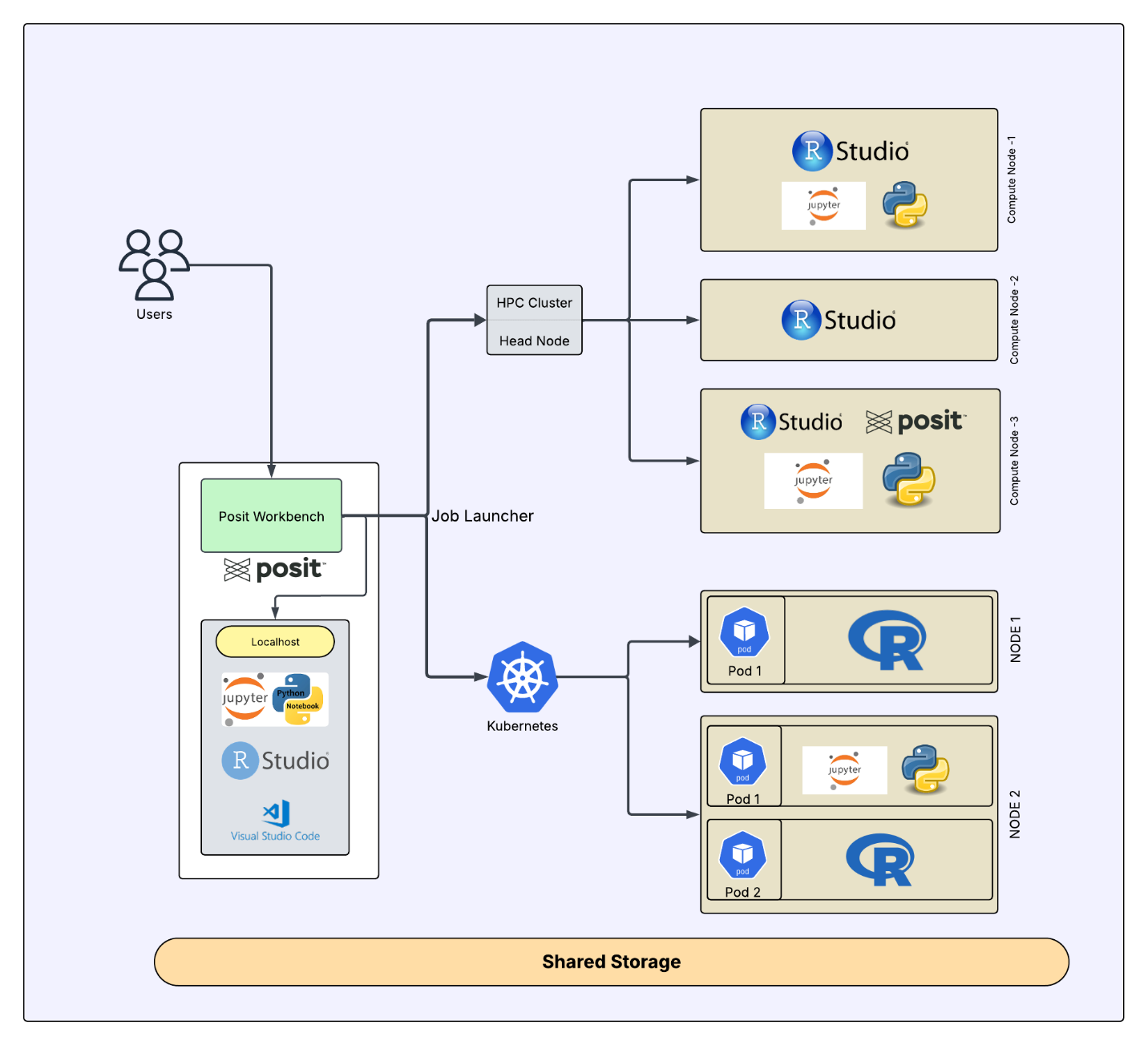
Posit has a dedicated job launcher feature that allows the developers to launch their sessions in an external environment (HPC/K8s) and additional IDE sessions like Python and R IDEs. This acts as the integration between the Slurm and PWB in case of HPC Integration and as integration between Kubernetes scaler and PWB.
Solution Architecture:
The architecture of the platform should be formulated based on the business use case and IT infrastructure good practices, there are multiple possibilities. Opting for the best-suited one is critical when delivering robust and cost-effective platform for the Use case we are trying to solve.
The Posit Workbench and Posit Connect can be integrated with scalable environments. As of the time of writing this article, the Posit Connect only supports integration with Kubernetes for hosting the Contents published environment.
Posit Workbench:
The Posit workbench with Job Launcher enabled can be integrated with Kubernetes/HPC/Batch environment. There are cases and scenarios where the Workbench would require integration with HPC and Kubernetes cluster enabling the developers to opt for the environment that is more optimal for their workflow. Generally, more stabilized workflows and repetitive tasks by the developers are orchestrated to the Kubernetes platform which will have predefined container images with specific R/Python Versions with required installations. For heavy workload with Parallel processing and long running jobs the HPC integration powered different types of instances for different workloads can be very effective for end results.
Posit Connect:
Posit Connect has a plugin to integrate with Kubernetes environment, which allows the contents to be spun up as pod in the Kubernetes node when a viewer/end user consumes them. This integration allows heavy loaded contents to be executed in the individual pods thus scaling of pods for multiple users.
The conceptual diagram below gives an overview on how Posit Workbench with Job Launcher can create session in Local Host/Kubernetes/HPC Environment.
(Source: Zifo Analysis)
Conclusion
In pharma data science, infrastructure is strategy. Choosing the right platform-whether HPC for precision workloads or Kubernetes for scalable, interactive analytics—can dramatically accelerate insights and impact. With Posit’s flexible architecture, teams can build reproducible, secure, and high-performing workflows that align with scientific goals and regulatory needs. The right architecture doesn’t just support innovation-it drives it.