








When people hear “Splunk,” they often think of a SIEM tool used for cybersecurity. But in the context of pharmaceutical R&D labs, Splunk is much more — it’s a data intelligence platform that empowers Lab IT teams to achieve operational excellence through real-time visibility, automation, and actionable insights.
Why Lab IT Needs a Smarter, Unified Approach
Pharma R&D labs are high-stakes environments where instrument uptime, data integrity, and workflow efficiency directly impact innovation timelines. Lab IT teams manage:
- A diverse mix of instruments (e.g., HPLC, GC, spectrometers)
- Scientific applications (LIMS, ELN, CDS)
- Network infrastructure and middleware
- Compliance with GxP and data integrity standards
Traditional monitoring tools often fall short in providing end-to-end visibility, leading to delays, inefficiencies, and audit risks.

Splunk in Lab IT: A Strategic Enabler
Splunk ingests and correlates machine data from across the lab ecosystem, enabling Lab IT teams to monitor, analyse, and act in real time.
Instrument Log Monitoring & Availability
Splunk collects logs and performance data from lab instruments to track uptime, detect anomalies, and ensure availability. Lab managers can instantly identify which instruments are online, idle, or experiencing issues—reducing downtime and improving lab throughput.
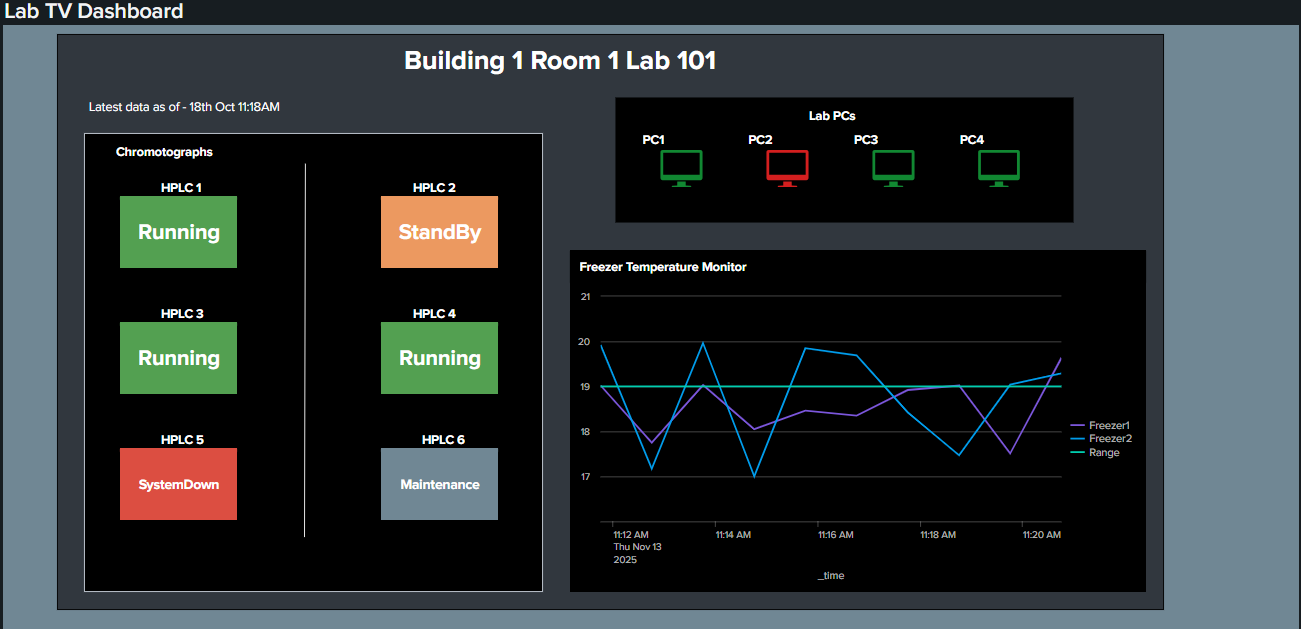
Real-Time Dashboards on Lab TVs
Splunk dashboards can be displayed on large screens across the lab floor, showing:
- Instrument status
- Experiment throughput
- System usage trends
- Network health
This fosters transparency, faster decision-making, and a culture of continuous improvement.
Experiment & System Usage Statistics
- Splunk aggregates data from scientific applications and infrastructure to provide insights into:
- Number of experiments run per day/week
- Resource utilization across instruments and systems
- User activity and workflow bottlenecks
These metrics help optimize lab scheduling, improve capacity planning, and support data-driven budgeting.
Automated Incident & Request Ticket Creation
- Splunk integrates with ITSM platforms like ServiceNow, Jira, or BMC Remedy to automate ticketing:
- Detects issues (e.g., instrument errors, network failures) in real time
- Automatically creates incident or request tickets with detailed diagnostics
- Routes tickets to appropriate support teams for faster resolution
This reduces manual effort, improves response times, and ensures consistent issue tracking.
Built-in Compliance Monitoring for GxP Environments
Regulated pharma labs must meet ALCOA+, 21 CFR Part 11, and EU Annex 11 requirements. Splunk becomes a strategic enabler by:
- Consolidating audit trails from instruments, CDS/LIMS/ELN systems, and infrastructure into a tamper‑resistant repository
- Providing real-time monitoring for data integrity anomalies, timestamp mismatches, unauthorized configuration changes, and missing audit entries
- Generating automated compliance reports for QA, audits, and periodic reviews
- Supporting CSV validation (IQ/OQ/PQ) for dashboards, alerts, and data flows
This makes Splunk a compliance accelerator, not just an operational tool.
Simplifying Integration Across a Highly Heterogeneous Lab Ecosystem
Lab IT landscapes are inherently complex—diverse instruments, proprietary log formats, middleware, data brokers, and segmented networks. Splunk becomes a strategic enabler by:
- Normalizing log formats from legacy instruments, modern devices, and scientific software
- Integrating multi-hop data flows through SDMS, LES, and file-transfer middleware
- Handling high-volume scientific logging with scalable indexing and retention strategies
- Maintaining secure connectivity across segmented lab networks, DMZs, and firewalls
This turns Splunk into the central nervous system connecting all parts of the lab ecosystem.
Splunk Features That Drive Lab IT Excellence
Splunk’s core features make it a powerful ally for Lab IT:
- Dashboards: Customizable views for instrument health, experiment stats, and system performance
- Alerts: Real-time notifications for anomalies, failures, or compliance breaches
- Reports: Scheduled or on-demand reports for audits, KPIs, and operational reviews
- Integrations: Seamless connectivity with ITSM tools, security platforms, and lab systems
These capabilities help Lab IT teams move from reactive support to proactive enablement.
Business Impact for Pharma Leaders
By adopting Splunk in Lab IT, pharma organizations can achieve:
- 30–50% reduction in instrument downtime as per Zifo estimate.
- Faster root cause analysis and issue resolution
- Improved audit readiness and compliance
- Greater lab productivity and scientific throughput
Operational excellence in Lab IT isn’t just about technology—it’s about enabling science, accelerating innovation, and delivering better outcomes for patients.
Conclusion
Splunk is not just a SIEM tool—it’s a strategic platform for operational intelligence. In pharma R&D labs, it empowers Lab IT teams to ensure instrument availability, streamline workflows, and automate support processes. The result? A smarter, faster, and more resilient lab environment.