


 Zifo
Zifo
Bridging Chemistry and Informatics: The Role of Click Chemistry in Managing Complex Bioconjugates

The biopharma landscape is rapidly evolving beyond traditional small molecules and biologics toward conjugated therapeutics, an innovative drug classes that combine multiple modalities for enhanced precision and efficacy. These include antibody-drug conjugates (ADCs), antibody-oligonucleotide conjugates (AOCs), and peptide-drug conjugates (PDCs), each designed to deliver targeted therapies with improved therapeutic index and reduced off-target effects.
As these conjugates gain prominence, they introduce two critical challenges:
- 1. Chemical complexity --requiring site-specific, stable linkages under physiological conditions.
- 2. Digital complexity -- demanding accurate representation and traceability in informatics systems for regulatory compliance and IP protection.
Why AOCs and Conjugates Matter? The Relevance and Evolution of Conjugated Therapeutics
Conjugated drug classes represent a strategic response to some of the toughest challenges in modern medicine:
- Targeting hard-to-reach tissues such as the central nervous system (CNS) and muscle, where traditional biologics often fail.
- Improving therapeutic index by delivering cytotoxic payloads directly to diseased cells, minimizing systemic toxicity.
- Addressing genetic and rare diseases through oligonucleotide-based approaches that modulate gene expression.
Antibody-Oligonucleotide Conjugates (AOCs) exemplify this evolution. By combining the targeting precision of antibodies with the gene-modulating power of oligonucleotides, AOCs open new frontiers in treating neuromuscular disorders and other conditions previously considered intractable.
It is worth noting that ADCs stand alone as a broadly validated therapeutic class, whereas PDCs have faced significant regulatory setbacks that limit their success to niche applications, and AOCs are currently at the emerging proof-of-concept stage without any approved products. However, rapid advancements in linker chemistry and site-specific conjugation are now solving these stability and delivery challenges, positioning the next generation of PDCs and AOCs to eventually join ADCs as pillars of modern precision medicine.
Market Outlook and Digital Readiness
Industry momentum underscores this shift. Forecasts from IQVIA and Evaluate Pharma predict sustained growth in novel modalities -- including ADCs and AOCs -- through 2030. Strategic moves like Novartis’ acquisition of Avidity Biosciences for $12 billion highlight the confidence in these platforms and their potential to redefine therapeutic paradigms.
As conjugates become central to drug pipelines, digital readiness is no longer optional. Accurate registration of complex structures, linkage chemistries, and experimental parameters is critical for regulatory filings, IP protection, and data-driven decision-making. This convergence of chemistry and informatics is where Click Chemistry offers a decisive advantage.
Click Chemistry Gains Prominence
Known for its modular, high-yield, and biocompatible reactions, Click Chemistry enables precise conjugation while simplifying digital registration workflows. For scientists, informatics teams, and regulatory professionals, understanding this intersection is essential to accelerate R&D and maintain compliance in a market poised for exponential growth.
Digital Representation Challenges in Conjugate Informatics
Electronic Lab Notebooks (ELNs) and Laboratory Information Management Systems (LIMS) were originally designed to handle either biologics or small molecules, but not the complexities of handling conjugates of the two. Keeping track of conjugates, like AOCs, in these systems requires drawing the combined molecule’s structure, accurately defining and maintaining the chemical link between its parts, while maintaining referential integrity to the individual components, which often stretches the capabilities of existing registration software or often requires complex customization. Below are some of the challenges:
- Preserving Source Component Links: Biologics and small molecules are handled separately, making hybrid conjugates difficult to maintain without losing key structural details.
- Incomplete Linkage Representation: Linking chemistry critical to conjugate function is poorly captured in systems lacking cross-domain structure support, hindering accurate viewing of the combined structure after cross-linking.
- Searchability: Key experimental parameters (linker ratios, conjugation sites, modifications) are often unstructured due to customized needs to handle linker chemistry. This could potentially lead to data searchability issues which is particularly important in conjugates as their development involves numerous cycles of varying experimental parameters as well as studying linkages across other conjugates before arriving at the optimal linkage chemistry.
- Regulatory and Traceability Challenges: During regulatory filings or patent submissions, reviewers expect clear traceability of experimental parameters such as conjugation ratios, linker composition, and modification sites. If the system can’t retrieve this information systematically, teams must manually reconstruct it which could be a time-consuming and error-prone process.
Click Chemistry - Fast, Secure, Precise
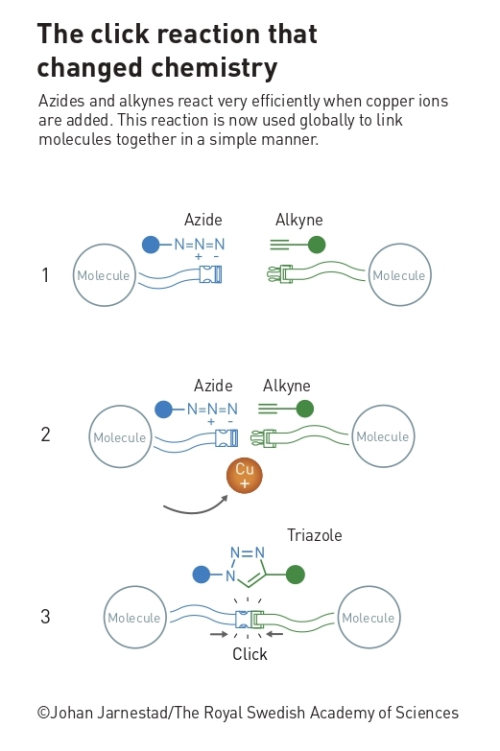
Click chemistry refers to a class of highly efficient, selective, and modular chemical reactions that “click” molecules together under mild conditions. A relatable analogy could be of a seatbelt. In order to fasten a seatbelt, you would need to use gentle force (favorable condition/catalyst) to push the seatbelt latch plate (one entity) into the buckle (second entity). Once you hear the "click" sounds, the seatbelt is now secure fastened.
The most commonly known click reaction is the azide–alkyne cycloaddition. These reactions are designed to reliably connect molecular building blocks without generating complex byproducts hence leading to higher yields and lesser need for purification.
Below are some key terminologies in understanding concept of Click Chemistry
- Click Core (or Click Core Residue): The reactive part of a molecule that forms a covalent bond during a click reaction -- such as an alkyne or azide on a peptide, oligonucleotide, or small molecule. It defines the "reaction site" where the two entities will join together.
- Leaving Group (in registration systems): Functional groups that are removed during the conjugation process. Tagging leaving groups in registration systems ensures that the final product’s structure and molecular weight are calculated accurately.
Why Click Chemistry?
Click chemistry has emerged as a robust and selective approach for constructing complex bioconjugates with molecular precision. Its mild, high-yield reactions enable consistent and site-specific conjugations that help streamline discovery workflows and analytical characterization. Below are some reasons why the approach is important specifically for conjugations.
- Site-Specific Conjugation
- Traditional chemistries often produce heterogeneous products (random attachment).
- Click reactions allow predictable attachment at defined sites on proteins or oligonucleotides, improving product consistency.
- Mild, Biocompatible Conditions
- Many proteins or oligonucleotides are sensitive to harsh reagents. Click reactions proceed under aqueous, room-temperature conditions, preserving biomolecule integrity.
- High Yield and Minimal Byproducts
- Conventional conjugation may require extensive purification due to side reactions. Click Chemistry products are more homogeneous, making analytical measurements (MS, HPLC, etc.) easier.
- Click chemistry produces clean, high-yield reactions, simplifying downstream purification.
Looking Ahead
As the bioconjugate market expands, biopharma companies must select the right digital tools to register and maintain these complex entities accurately. Proper management is essential not only for protecting intellectual property but also for ensuring regulatory compliance and generating reliable reports for FDA approvals. Incorporating the right tools can also empower scientists working with bioconjugates to track critical parameters, identify trends, and make data-driven decisions, ultimately accelerating research and development.